New battlefield, same war.
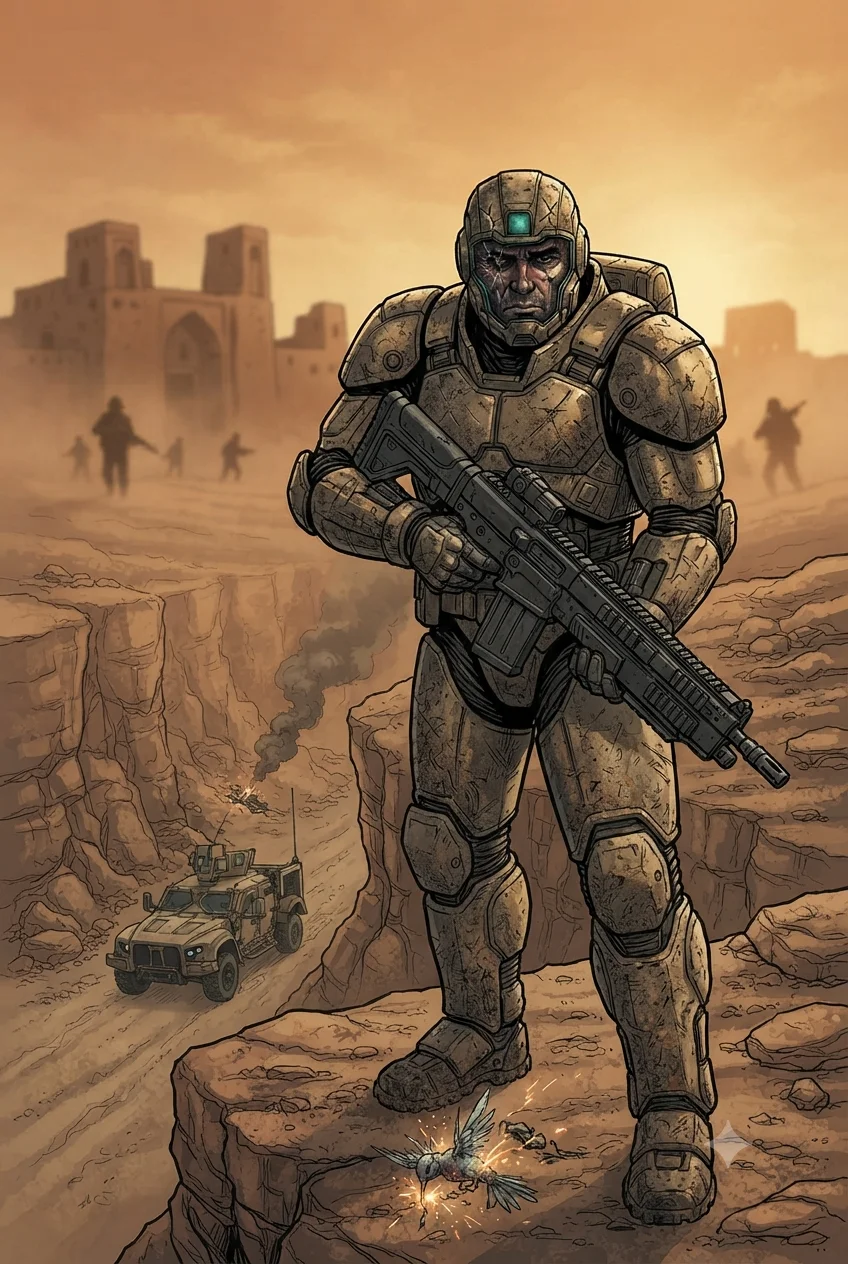
The heat didn’t just sit on the skin; it hummed with the electric whine of the hardware that supposedly made them gods of the battlefield.
Staff Sergeant Marcus Vance checked his Integrated Helmet System. A translucent overlay painted the landscape in shades of infrared and thermal data. To his left, a persistent green chevron tagged a squad member’s vitals: heart rate, hydration levels, ammunition count. Behind him, a micro-drone—no larger than a hummingbird—tethered to his shoulder, providing a 360-degree augmented reality view of the valley ahead. He didn’t just see the terrain; he saw the digital ghost of every potential threat, calculated by predictive algorithms that had analyzed two decades of insurgent tactics.
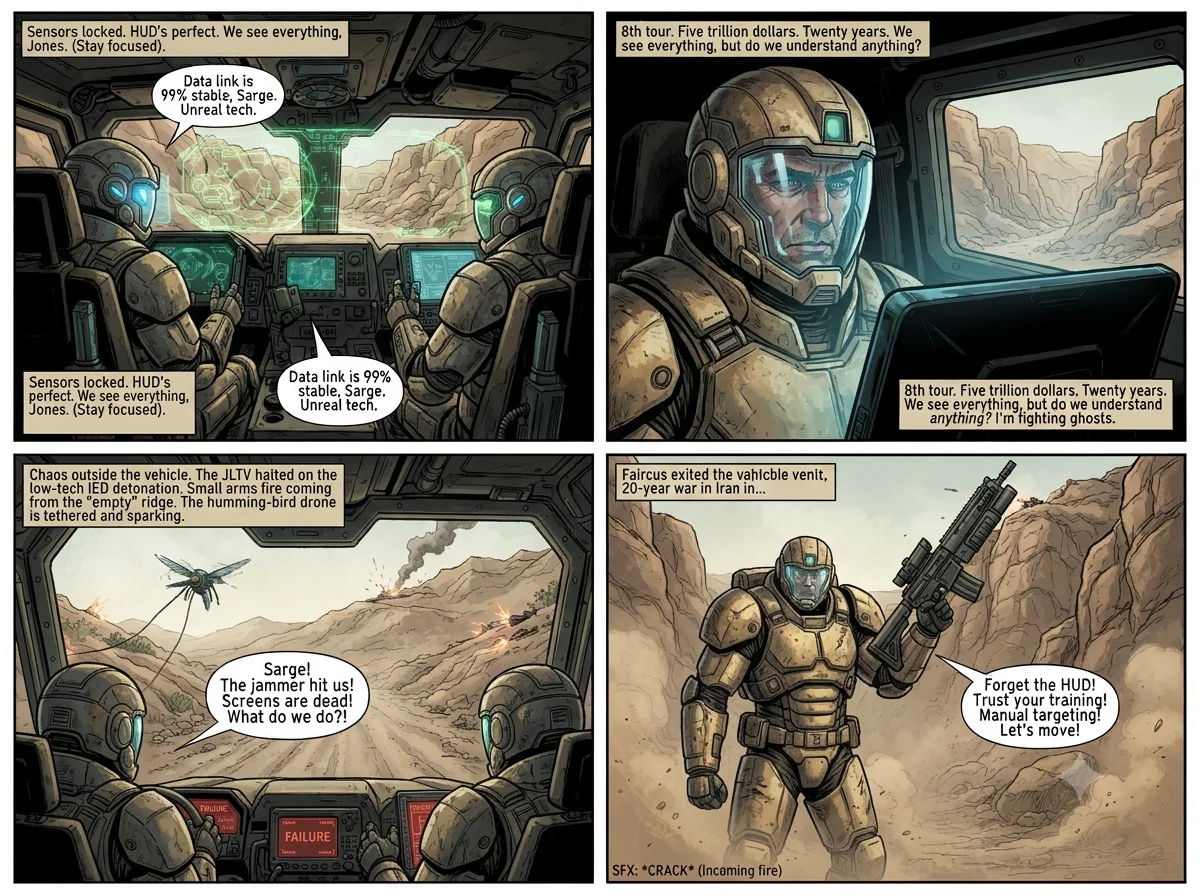
“Syncing HUD to the orbital relay,” his driver muttered, tapping a touchscreen console that glowed with tactical maps in real-time. “Data link is 99% stable. We’re literally seeing through walls today, Sarge.”
Marcus stared at the “perfect” battlefield. The sensors were flawless. The intelligence was absolute. He watched as a high-velocity, autonomous kinetic strike unit cruised overhead, its AI capable of distinguishing a weapon from a farm tool at three miles away. They had spent five trillion dollars to eliminate the “fog of war.” They had turned the battlefield into a spreadsheet.
And yet, as the vehicle rounded a sharp bend in the arid, unforgiving canyon, the sensors flickered. A sudden, primitive burst of electromagnetic interference—likely a cheap, scavenged jamming device cobbled together from washing machine parts and decades-old wire—washed over them. The high-tech overlays in his visor stuttered and went black, leaving him staring at the harsh, brown reality of the earth.
In that silence, a single, low-tech insurgent trap detonated in the distance, followed by the familiar, unmistakable pop of AK fire from a position their sensors had deemed “empty” just seconds before.
“Tech’s down,” Marcus barked, his voice sharp and familiar. “Manual targeting. Eyes on the ridge. Forget the data, trust your training.”
As the driver frantically tapped at a frozen screen, panicked because his god-like perspective had been stripped away, the interior of the vehicle seemed to shrink around Marcus. He sat motionless for a heartbeat, the digital silence ringing in his ears. After eight tours, his reflection in the dark, dead screen of the dashboard looked like a stranger—a man whose face was a map of twenty years of tactical errors and geopolitical dead ends. He had spent his entire adulthood mastering the science of killing an enemy he still couldn’t name, let alone understand. Was he a soldier, or just a very expensive cog in a machine that had forgotten its purpose?
He looked at his hands, calloused and steady, then at the rifle he held like a penance. He had been so busy optimizing the war, calculating trajectories and managing data streams, that he had never stopped to ask if the war was ever intended to be won, or if he was simply serving out a life sentence in the sand. With a heavy, exhaled breath that seemed to carry the weight of two decades, he shoved his doubt into a dark corner of his mind where he kept all his other ghosts. He clicked the safety off, forcing himself to forget the philosophical abyss and focus solely on the immediate, lethal reality of the next sixty seconds.
“Leave the screen, kid,” he said, his voice flat and devoid of the certainty he used to feel. “Welcome to the real fight.”
Like this bullshit? Consider buying me a coffee!