Camp Ramesses
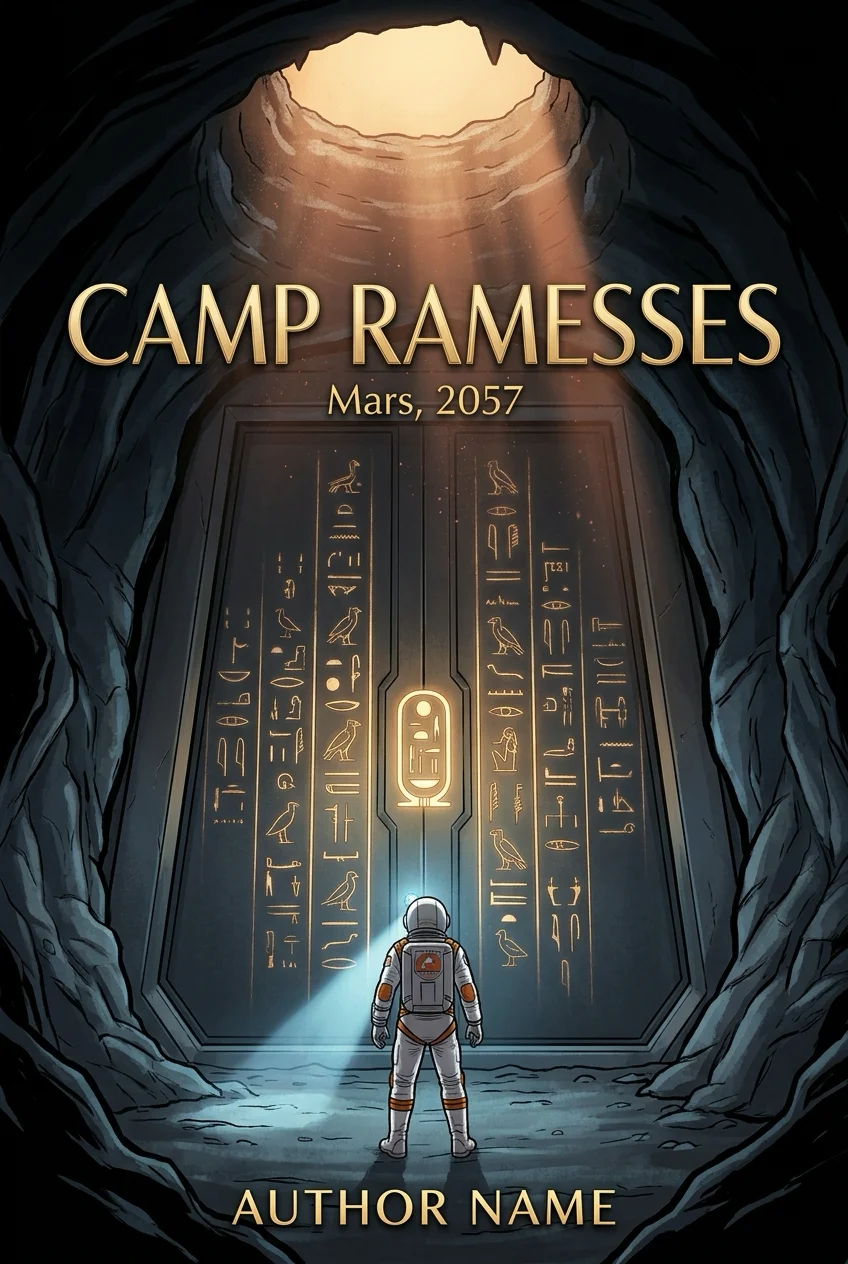
Mars, 2057
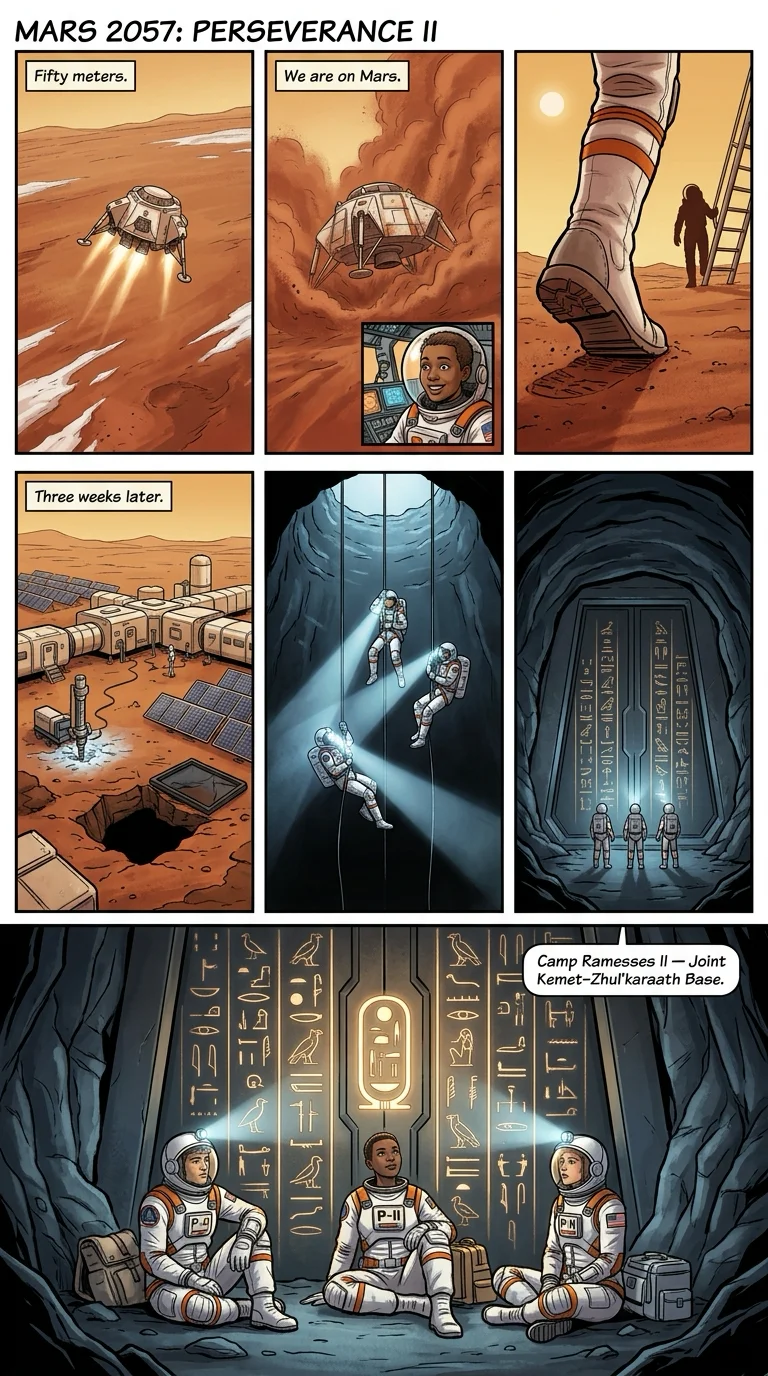
The descent took seven minutes, and for every one of them, Commander Amara Okonkwo forgot to breathe.
Below the lander Perseverance II, the north polar plains of Mars rolled out like a rust-colored ocean, streaked with the white of ancient ice. It was the year 2057, nearly ninety years after the first boots touched the Moon, and a decade after the lunar colony had grown from a handful of domes into a proper town. Humanity was finally about to stand on another world.
“Two hundred meters,” said her pilot, Tomas Reyes, his voice thin. “Fifty. Ten.”
The engines roared and the dust rose in a great red curtain. Then, gently, the ship settled.
Silence.
“Mission Control,” Amara whispered, “Perseverance is down. We are on Mars.”
The delay swallowed her words for twelve long minutes. When the cheering came back, it was faint and beautiful, like an echo from home.
They chose the landing site for one reason above all others: the lava tubes. Ancient rivers of molten rock had carved long tunnels beneath the surface here, and tunnels meant shelter from the radiation, from the storms, from the cold. Next to them, buried under the dust, lay water ice, enough to keep a colony alive for a century.
Amara climbed down the ladder, one rung at a time. Her boot sank into the powdery soil, leaving a print sharp as a stamp. The sky above was butterscotch, the sun small and pale. She looked at the horizon, so close and so strange, and she said the only thing that came to her.
“It’s so quiet. Like the whole planet is holding its breath.”
It took three weeks to build base camp: the habitats, the solar fields, the ice drill humming day and night. Then, at last, it was time to go underground.
The first team, geologist Iker Salas, engineer Lena Voss, and Dr. Priya Nair, the mission’s physician, roped down through a collapsed skylight into the dark. Their helmet lamps swept across walls of smooth black basalt, glazed like glass. The tunnel stretched ahead, wide enough to drive a train through.
They walked for nearly a kilometer. Nobody spoke much.
“Base, this is Salas,” Iker said finally, and his voice had changed. “I need everyone listening to stay calm. We’ve found something.”
The tunnel ended in a wall. But it wasn’t a wall of stone.
It was a door.
Tall, perfectly symmetrical, its surface a dark metal that reflected no light, fitted so precisely into the rock that not even a blade of dust could pass its edges. And covering it, from floor to ceiling, in neat vertical columns, were symbols.
Birds. Reeds. Wavy lines of water. A seated figure with a jackal’s head.
“Those are hieroglyphs,” Lena breathed. “Those are Egyptian hieroglyphs.”
Priya reached out a gloved hand and stopped just short of touching them. Her voice shook. “That’s impossible. We’re two hundred million kilometers from the Nile.”
They photographed every inch. The images went home, and for six hours, Earth went quiet.
Down in the tunnel, no one slept. They just sat before the door, lamps dimmed, waiting.
At last the radio crackled. It was Houston, and the flight director sounded like a man who had been crying and laughing at the same time.
“Perseverance, we have a translation. Our Egyptologists at Cairo and Oxford have confirmed it, three times over. Most of it is standard Old Kingdom script, with a few… unusual additions. Phonetic spellings of sounds that don’t exist in any human language.”
“Just read it,” Amara said.
A pause. The static hissed.
“It says: Camp Ramesses the Second. Joint Kemet–Zhul’karaath Base.”
Nobody moved. Nobody breathed.
And then Iker began to laugh, quietly at first, then helplessly, the kind of laugh that comes when the universe turns out to be far stranger, and far less lonely, than anyone had dared to hope.
“Kemet,” Priya whispered. “The old name for Egypt. The Black Land.”
Amara looked at the door, at the birds and the reeds and the name of a pharaoh who had died three thousand years before anyone dreamed of rockets.
Somebody had been here first.
And they’d left a light on.
Like this bullshit? Consider buying me a coffee!