The Defence
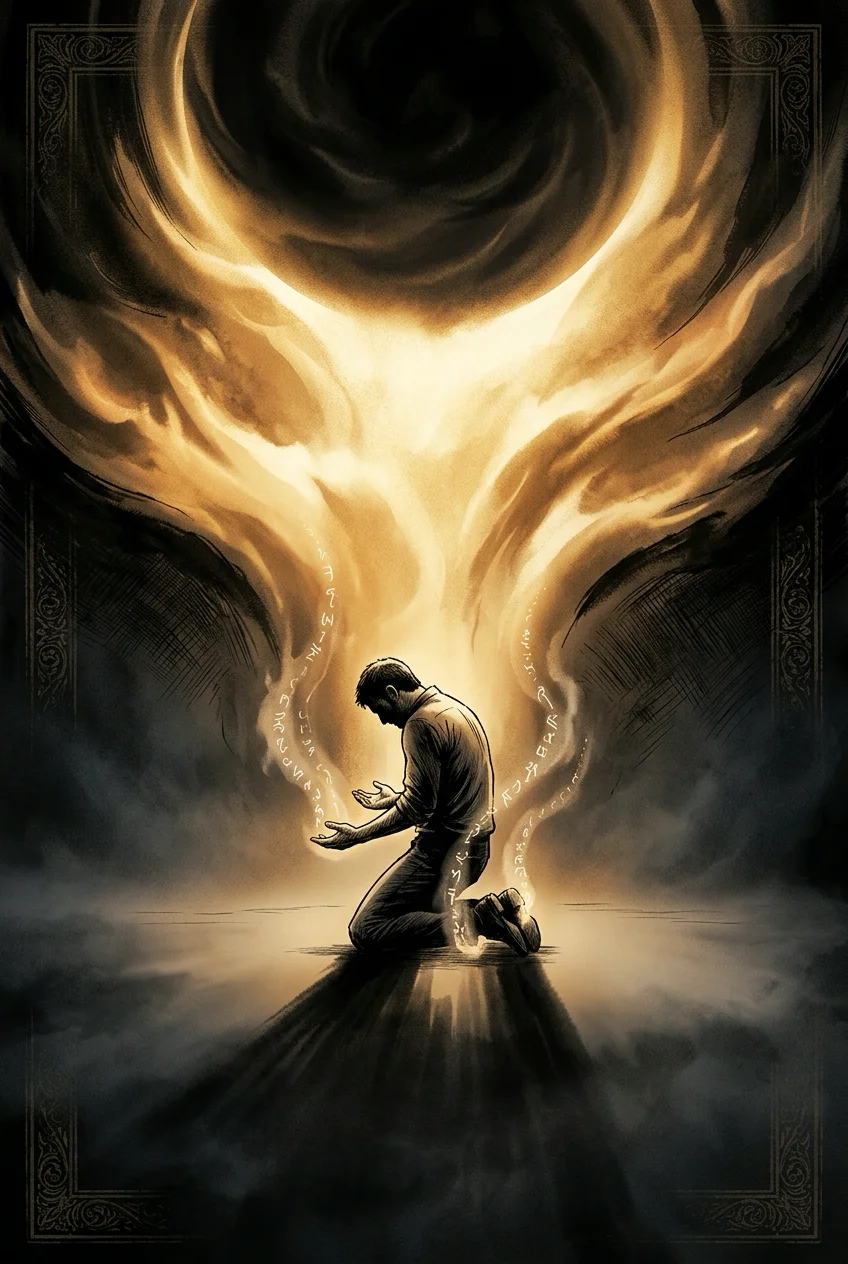
There was no courtroom.
He had expected scales. A bridge. Fire somewhere off to the left. There was only a floor that was not a floor, a light with no source, and the sudden, total knowledge that he was known.
He tried to speak. His mouth would not open.
So his hands spoke instead.
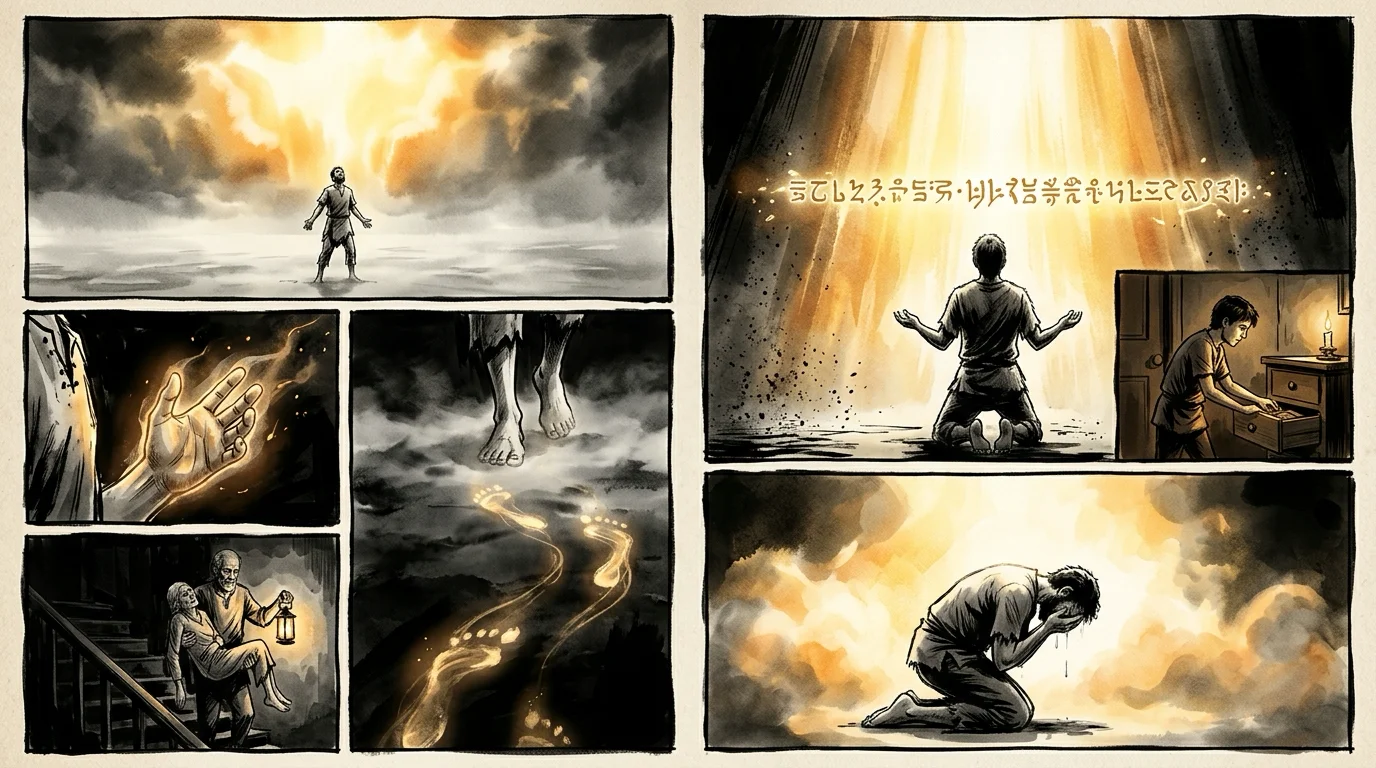
His right hand went first, in his own voice, and it talked about the money — the small amounts, then the larger ones, then the signature that was not his. His feet named the doors they had carried him through. His skin testified last, and that was the worst of it, because skin remembers what the mind agrees to forget.
It took eighty-one years. It cost nothing. Time was no longer something he was spending.
When the last of him fell silent, the seal lifted from his mouth.
WHAT IS YOUR DEFENCE?
Not a voice. Nothing so small as a voice.
“I wasn’t religious,” the man said. “I should say that first. I didn’t pray. I fasted twice, and one of those was a diet.” The light waited. “I thought it was all weather. Something people did where I grew up.”
WHAT IS YOUR DEFENCE?
“That is my defence. I was wrong — obviously, you’re here, so the message was true.” He turned his palms up; they were only hands again. “But if it’s true, then all of it is true. And one of the articles of faith is the decree. Everything written before anything was made. The ink dry before my grandfather drew breath.” His voice found its footing; he had been good at this, in life. “So if it was written that I would do these things, how were they ever mine?”
The record opened.
He had seen it before. Now he saw it properly. Beside every deed, in the same hand, his reasons. Not today. Nobody will know. I’ll put it back next month. She had it coming. Line after line after line of a man deliberating.
A script doesn’t record the actor’s reasons, he thought, and did not know where the thought had come from.
YOU KNEW YOUR SON. YOU KNEW HE WOULD TAKE THE LAST OF THE BREAD BEFORE HE REACHED. DID YOUR KNOWING MOVE HIS HAND?
“No.”
I DO NOT FORESEE. THERE IS NO BEFORE IN ME. I SEE.
The man said nothing.
NAME ONE ACT IN THAT RECORD YOU DID NOT WISH TO DO.
He searched. He found one — the checkpoint, the gun at his neck, the paper he had signed with a man’s hand around his throat. He looked for it in the record. It wasn’t there.
“It isn’t written down.”
NO. IT IS NOT.
YOU MAKE THIS ARGUMENT NOW. DID YOU MAKE IT AT THE DRAWER? DID YOU SAY, IT IS DECREED? OR DID YOU SAY, NOBODY WILL KNOW?
He didn’t answer.
AND THE NIGHT YOU CARRIED YOUR NEIGHBOUR DOWN NINE FLIGHTS IN THE DARK — DID YOU CALL THAT DECREED? OR DID YOU TELL IT FOR THIRTY YEARS AS SOMETHING YOU DID?
WOULD YOU LIKE TO GO BACK?
And it was real. His whole life stood open behind him like a door left ajar. He was fifty-one again. The drawer was open. The house was quiet. His hand was warm.
He took the money.
Then the floor that was not a floor, and he was weeping.
“I’d do it again,” he said. “Not because I had to.” His mouth was dry. “Because it’s mine. It was always mine. The writing only got there first.”
WHAT IS YOUR DEFENCE?
And he understood, at last, that he had spent the whole of his death arguing a case and the whole of his life earning one — and that in eighty-one years, not one letter of the decree had ever stopped him from saying the only sentence worth saying.
“I have none,” he said. “Forgive me.”
The light did not roar. It came closer.
THIS, TOO, WAS WRITTEN.
Editor’s note: A discussion on free will vs predestination. The story is the answer LLM engines give. Several LLM engines basically give the same answer. I guess a consensus report based on all knowledge in the internet.
The body as witness. The opening image comes from the Qur’anic scene of the day mouths are sealed and hands speak while feet bear witness — the sinner’s own limbs turned state’s evidence.
Knowing isn’t causing. Boethius’ answer to this exact objection: God does not foresee from inside time, He sees the whole of it at once, and knowledge of an act no more compels it than a mother’s certainty about her son moves his hand. The Ash’ari doctrine of kasb makes the same move from the other side — God creates the act, the man acquires and owns it.
Compulsion is the real exemption. Classical law excuses what is done under ikrah, genuine coercion, and holds you to what you did willingly. The one act he can honestly say he didn’t want to do turns out to be the one act missing from the record.
When the plea is made. In the well-known report, Adam defeats Moses by invoking the decree — but for a calamity already fallen, not for a sin not yet committed. The scholars’ rule has always been: the decree explains what happens to you; it never excuses what you choose. Nobody in history has ever used predestination to talk himself into a theft; it only ever gets used afterwards, and only ever for the bad half of the ledger.
The compatibilist trap. He’s offered the rewind, which is the only test that matters — and he does the identical thing, because the act flowed from his own wanting rather than from something outside it. That’s not the decree overriding him. That’s the decree being an accurate description of a man.
And the mercy. The paradox only stays a cage while he’s arguing. The final line dissolves it: repentance isn’t an exception to the decree, it’s inside it. If everything is written, so is the asking — and mercy, in this theology, always got there first.
Like this bullshit? Consider buying me a coffee!