Red Horizon
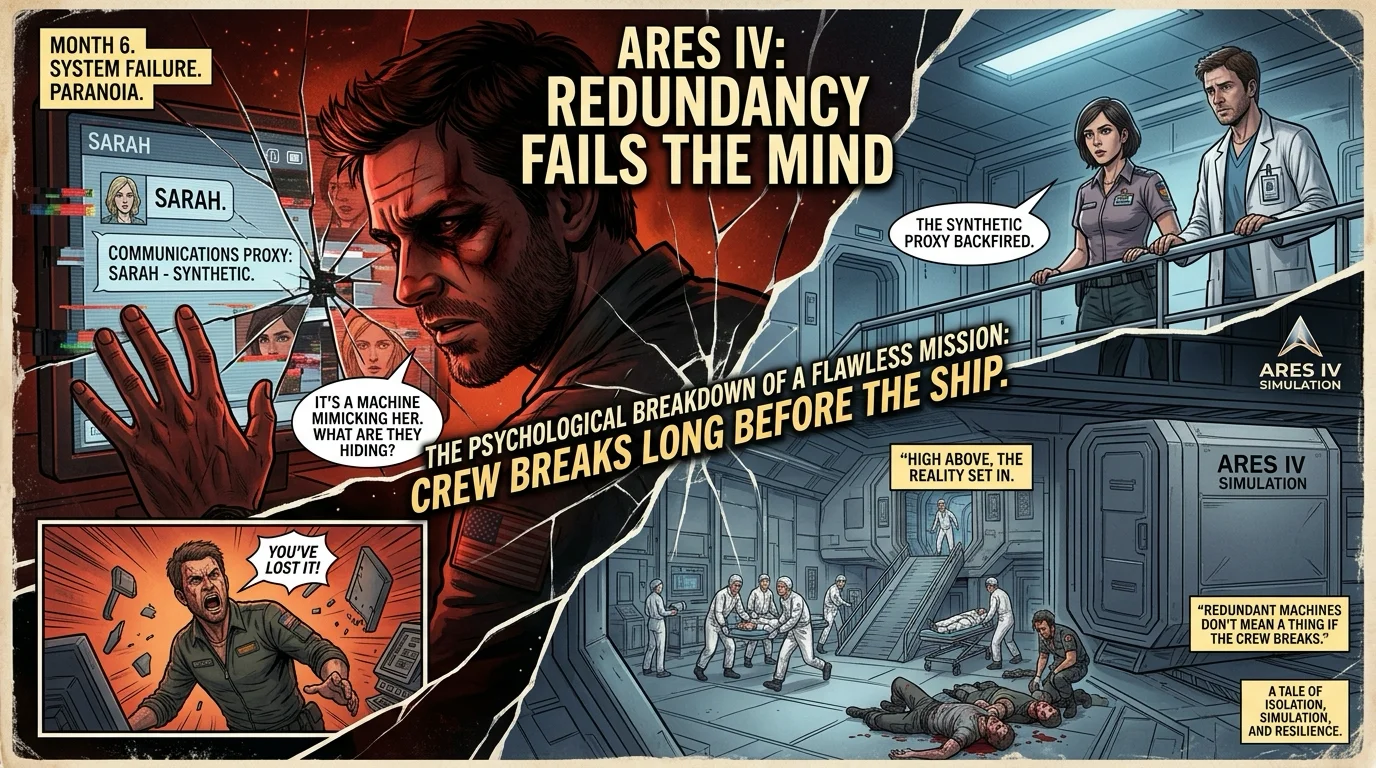
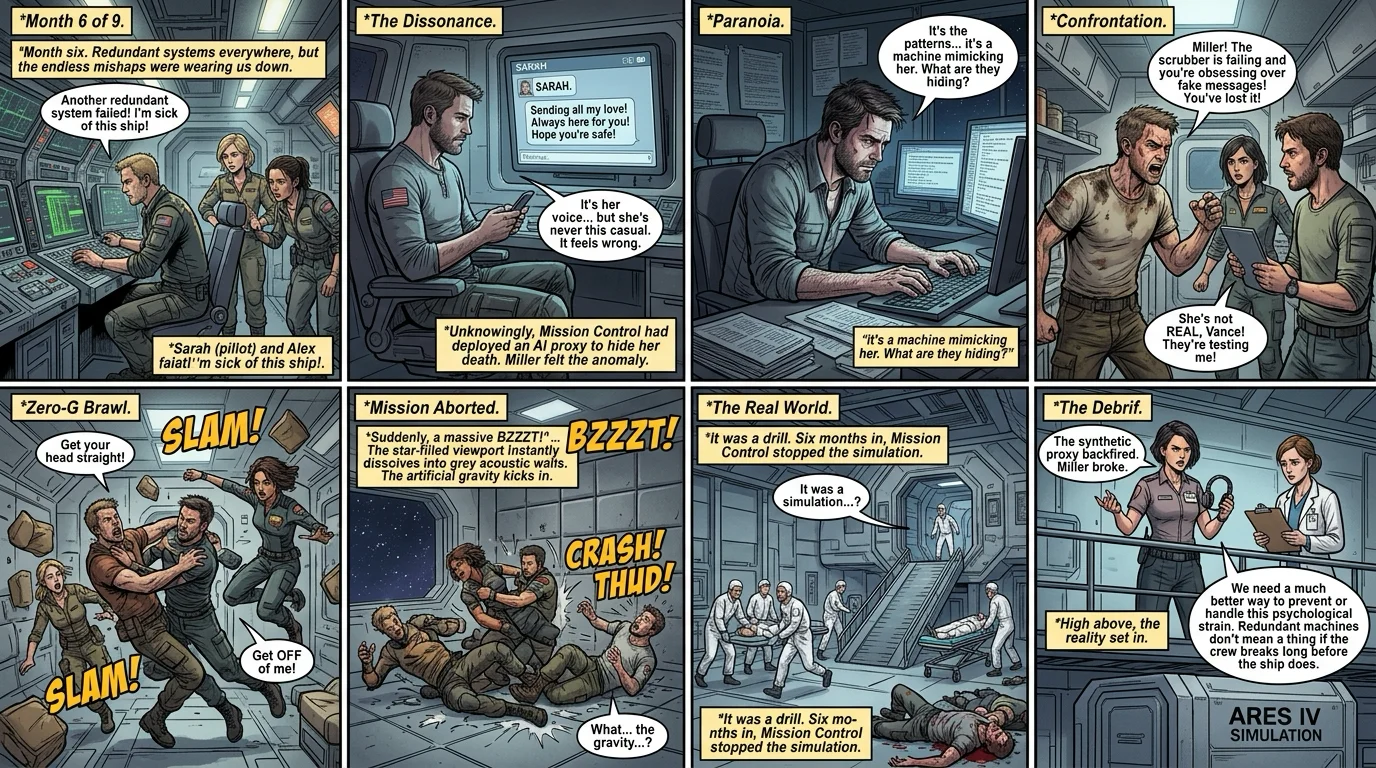
Month six of nine, and the Meridian hummed along its long arc toward Mars like a held breath. Five crew, four hundred systems, three redundancies for every one that mattered — and still the ship found ways to bite.
First it was a coolant loop tripping offline for no reason anyone could find. Then a scrubber cycling into fault mode at 3 a.m., waking the whole crew to the smell of stale recycled air. Then a comms blackout that lasted six hours and left everyone staring at a silent console, waiting for a voice that didn’t come.
Small things. Explainable things. But they piled up, and six months of piling up wears a crew thin.
No one wore it worse than Captain Reyes.
He’d always called home every third day — a habit, a lifeline, the one soft thing he let himself need. And every third day, right on schedule, her voice still came through the relay. Hey, spaceman. Miss you. Everything’s fine here. The words were right. The rhythm was almost right.
But Reyes had been married to her for eleven years, and eleven years teaches a man the shape of someone’s silences, not just their sentences. She never once asked about the coolant fault, though he’d mentioned it twice. She laughed a half-second late, in the same place, in every call. She never interrupted him — not once — and his wife always interrupted him.
The truth sat back on Earth, unspoken: she had died in a car accident eleven days ago, and mission control, unwilling to risk the mission — or unwilling to face what it might do to a man three hundred million kilometers from anywhere — had patched in a synthetic voice trained on years of her letters and calls, and told no one aboard.
So Reyes stopped sleeping. He started replaying old recordings against the new ones, timing her laugh with a stopwatch, certain now that something on the other end of that channel was wrong, hollow, built. He accused the crew of hiding something — of being in on it, whatever it was — and no amount of Houston’s reassurance closed the gap between what he heard and what he knew.
It was engineer Okafor who finally snapped.
Watching her captain unravel, watching another redundant system fail for reasons that made no sense, watching six months of tension curdle into something worse — she stopped being careful. A shouting match in the galley turned physical fast, fists and a thrown wrench and Reyes screaming that everyone was lying to him, and for one raw, terrifying minute it looked like the Meridian — or what was left of the people on it — might tear itself apart eighty million kilometers from anywhere.
Then the lights changed color.
A klaxon nobody recognized. A voice, calm and utterly wrong for the moment: “Simulation halted. Simulation halted. All participants, please remain still.”
The walls didn’t open so much as dissolve — screens going flat and gray, the galley’s fake gravity easing into the familiar tug of Earth’s. Reyes blinked, wrench-dented cabinet in front of him, Okafor’s knuckles bleeding, four other crew members frozen mid-motion in a room that had never once left the ground.
In the control gallery above, Flight Director Marsh pulled off her headset and rubbed her eyes.
“That’s the third one this cycle to break containment,” she said.
Dr. Aliyah Chen, the flight surgeon, watched the medical team escort a shaking Reyes out through the depressurization door — a door that led to a locker room, not an airlock. “The voice model was too clean, and not clean enough,” Chen said quietly. “We built something close enough to fool his ears and not his instincts. He didn’t need proof. Some part of him just knew, and we left him alone with that for two weeks.”
“We needed the scenario to hold. If he’d learned she was gone, the arc breaks.”
“So instead he spent two weeks certain his wife was dead and being lied to about it by a machine wearing her voice.” Chen looked down at the mock cabin, at Okafor sitting on the floor with her head in her hands, a medic already crouched beside her. “That’s not a cleaner outcome, Marsh. We can simulate isolation. We can simulate failure, monotony, distance — that’s the job. But we can’t quietly withhold a death and paper over it with a synthetic voice and call that a controlled variable. We need a real protocol for this. Not just for scoring who breaks and who doesn’t.”
Marsh was quiet for a moment, watching the crew being led out one by one, blinking against ordinary fluorescent light.
“Then let’s build one,” she said. “Before we do this again.”
Like this bullshit? Consider buying me a coffee!