Krater Field, Vienna -- 1943
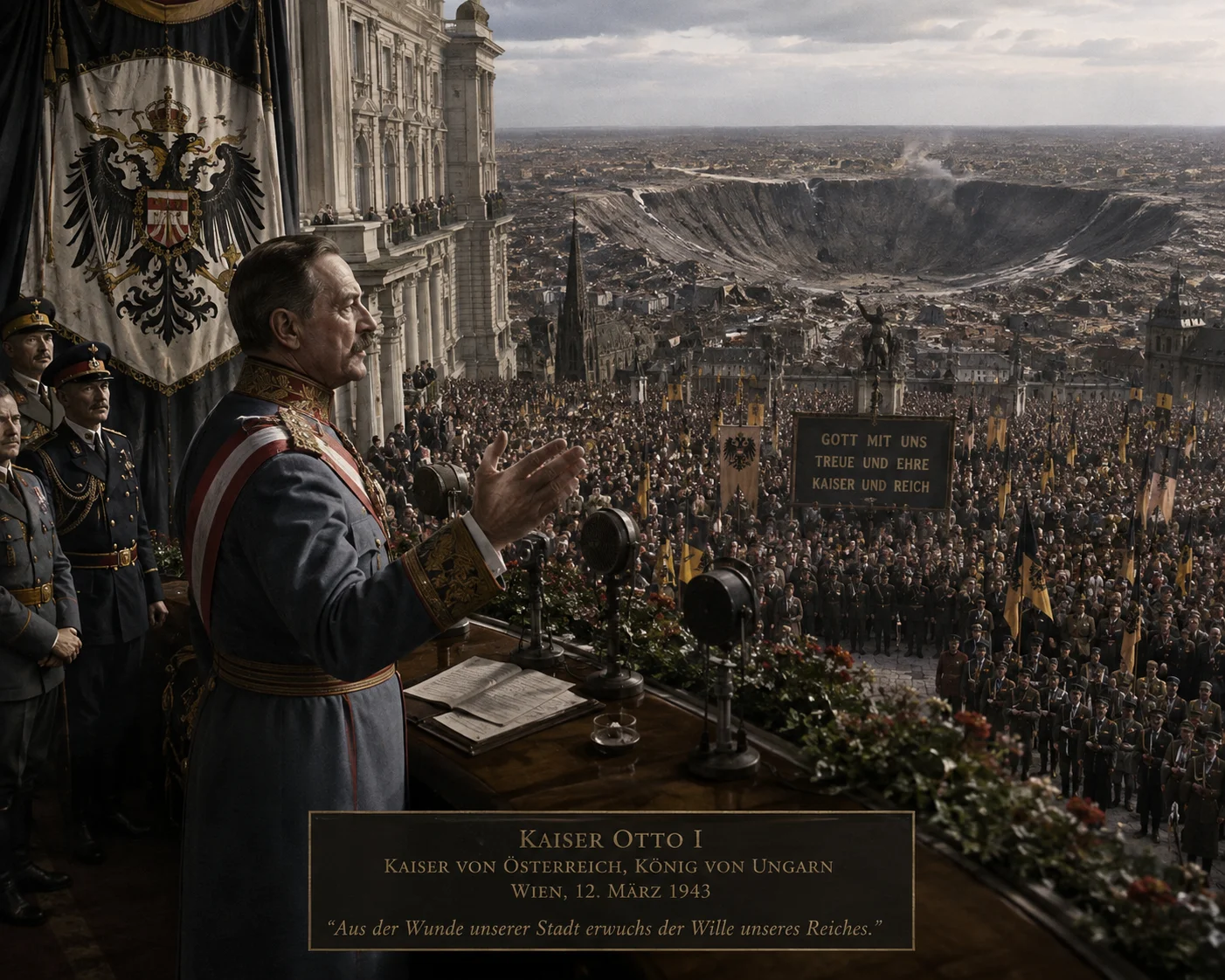
Vienna, the edge of the Krater Feld, 15 January 1943
My people—Germans and Magyars, Czechs and Poles, Croats and Slovenes, Ruthenians and Italians, Jews and Romani, all who call this Empire home—
We gather today where a city once stood.
Thirty years ago, on a January morning much like this one, the heart of Vienna vanished. In an instant of light no astronomer has explained and no priest has fully consoled, two million souls were taken from us—among them my grandfather, the Emperor Franz Joseph, who had reigned since before living memory; my cousin Franz Ferdinand, who would have worn this crown before me; and countless ordinary Viennese—bakers, teachers, students, mothers—who simply woke that morning in the wrong part of a city they loved.
I was an infant then, carried from the nursery at Schönbrunn only because fate, or providence, placed me beyond the crater’s reach. I did not choose to survive. I have spent thirty years trying to be worthy of having done so.
We do not fully know what struck us that morning. Perhaps we never will. But I tell you what we have learned in the thirty years since—for grief, if we let it, can still become wisdom.
The old Europe that stood at the edge of this crater in 1913 was a Europe sharpening its knives. Empires circled one another over colonies and coal, over ancient grudges and new ambitions. Historians tell me that in Berlin and St. Petersburg, in Paris and London, war was being drawn up on maps like a certainty, needing only a spark. We now believe, though we cannot prove it, that Vienna very nearly provided that spark. Instead, this city provided something else: a warning written in vitrified stone, a wound so vast that even the proudest chancelleries of Europe looked upon it and lost their appetite for war.
The great powers, staring into this crater, chose caution over conquest. Mobilization orders were quietly withdrawn. Alliances built for war were, year by year, rebuilt for commerce, for science, for the medicine that has since conquered diseases that once emptied our nurseries. We do not know, and cannot know, what furies might have been unleashed in the world that did not come to pass—what movements of hatred, what tyrants might have risen from humiliation and chaos, had the old order simply collapsed in blood as so many once expected. We only know that they did not rise here. That the century did not darken as it might have.
And so Austria-Hungary, too, was remade—not by the sword, but by necessity and, I dare say, by grace. The Empire I inherited was not the brittle house of nationalities my grandfather struggled to hold together. It is a federation now, where the Diet of Prague and the Sabor of Zagreb and the Parliament of Budapest each govern their own peoples in their own tongues, bound together not by force but by a Crown that has learned, at terrible cost, that unity cannot be commanded—only earned.
We are not a perfect union. We argue, as free peoples must. But our trains run between Vienna and Warsaw without customs delay. Our universities teach in a dozen languages. Our physicians and engineers are welcomed from Trieste to Lemberg. We have built, from catastrophe, something that endures.
Let us be honest, too, in this solemn hour: we do not celebrate what happened here. Two million dead cannot be redeemed by any peace that followed. We do not thank the wound for the healing. We only bear witness that in the depths of an unimaginable loss, this Empire, and this continent, chose a different road than the one they had been walking.
So let this crater remain as it is—unbuilt upon, ungilded, honest in its emptiness. Let our children come here not to marvel, but to remember: that peace, once nearly lost to arrogance, was found again in humility. That the price of forgetting is written plainly in the ground beneath our feet.
To the two million: we have not forgotten you. To Austria-Hungary, and to a Europe at peace: may we prove worthy of the second chance your absence purchased for us.
God preserve the Empire. God grant us the wisdom never to need so terrible a lesson again.
Like this bullshit? Consider buying me a coffee!