The Red Eagle of Leipzig
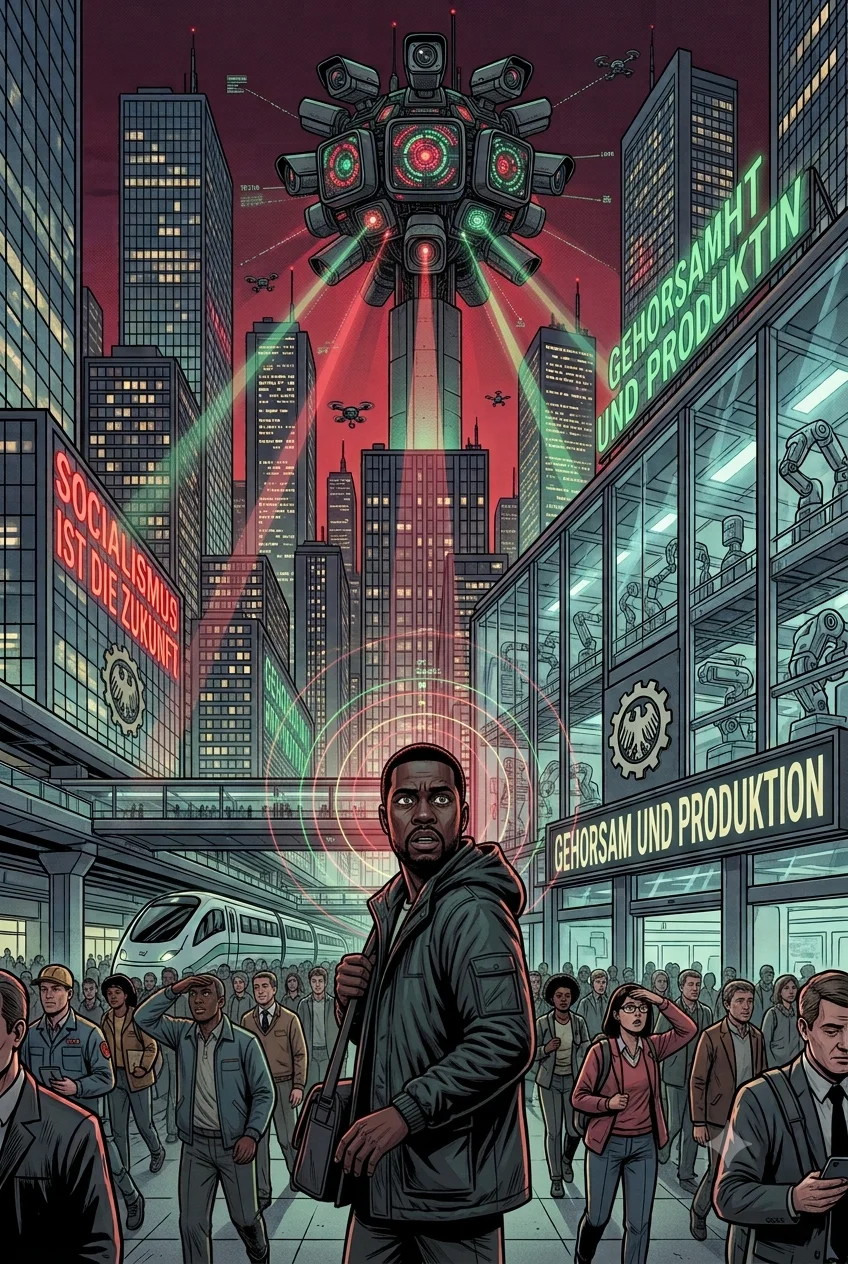
The Red Eagle of Leipzig
Kofi adjusted the lapels of his nylon parka as the 7:15 AM high-speed maglev train glided quietly into Leipzig’s Central Terminal. It was October 1992. Sixty years after the National Socialist Workers’ Party consolidated power and nationalized the nation’s industries, Germany had transformed into an economic titan. By taking back its pre-war territories without triggering a global conflict, the State had spent decades refining its ideology—merging strict state-led socialism with controlled capitalist enterprise.
In essence, it was Socialism with German Characteristics.
Kofi, born in the colonial West-African province of Togo-West, worked as a systems analyst at the Volk-Telekom foundry. Under the State’s imperial-socialist framework, residents of overseas territories were integrated into the national labor pool as equal industrial comrades, provided they maintained strict party loyalty.
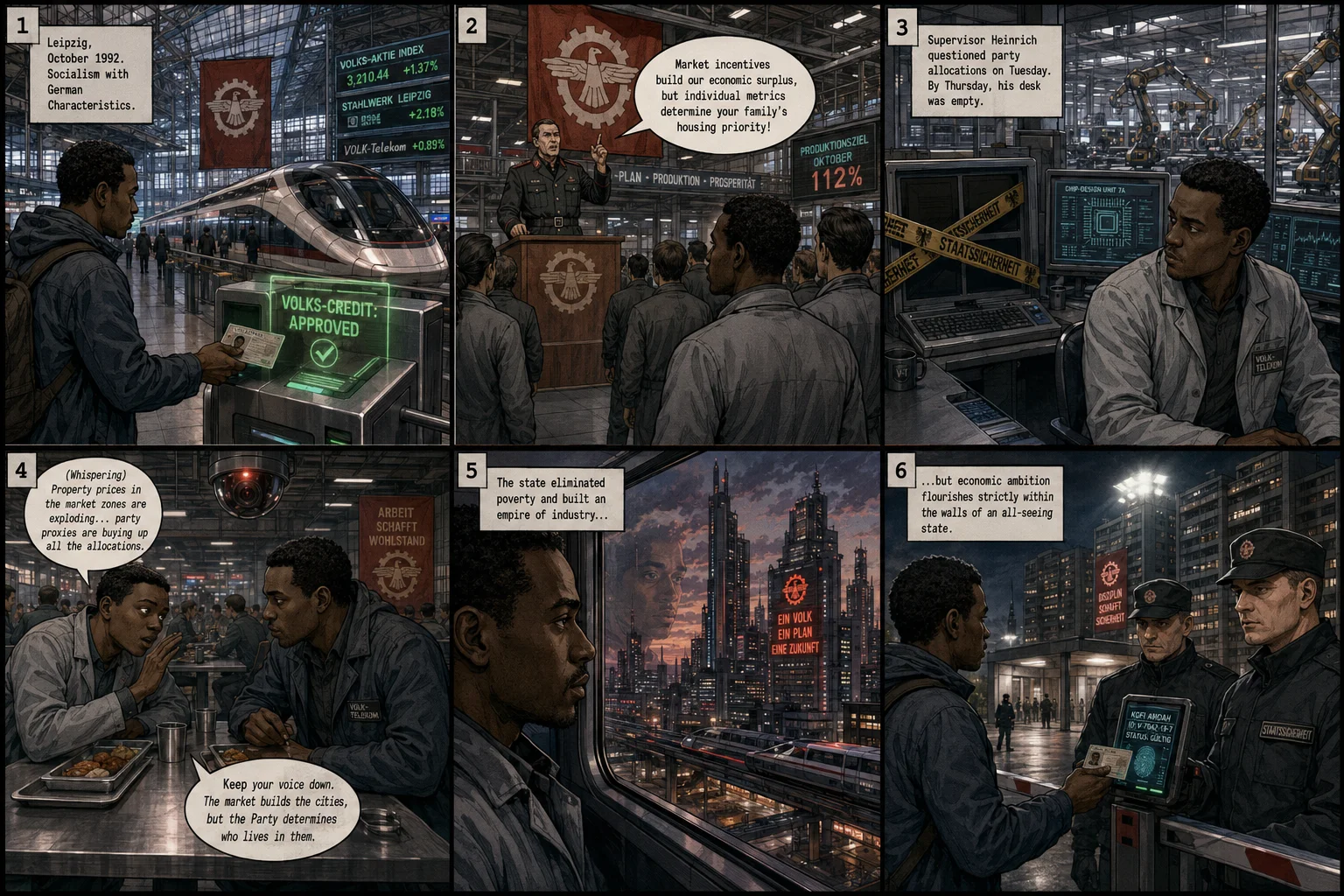
Walking down the grand concourse, Kofi tapped his electronic identity card against a kiosk scanner. A green light flashed, confirming his Volks-Credit score was in good standing. Above him, massive digital screens alternated between stock indices for state-approved joint ventures and slogans praising collective discipline.
At the foundry, the morning briefing was led by Comrade Weber, the factory’s Political Officer. Weber stood beneath a banner displaying a stylized gear and eagle.
“Our market-socialist reforms in the Saxon Special Economic Zone yielded a twelve percent export surplus this quarter,” Weber announced, pacing before the rows of engineers. “Private enterprise brings capital, but the Party retains the wheel.” He fixed his eyes on the crowd. “However, output in Section 4 fell short. Remember: market incentives do not excuse individual complacency. Your individual performance metrics impact your family’s housing priority.”
Kofi sat at his terminal, monitoring the automated microchip assembly lines. The economic synthesis was undeniable; high-speed rail linked Berlin to Lomé, consumer electronics filled store shelves, and state-backed private firms competed globally.
Yet, the friction of the system was everywhere. To Kofi’s left, an empty desk belonged to his senior supervisor, who had quietly vanished two days ago after raising questions in a internal bulletin about party officials skimming profits from a joint-venture contract. No one spoke his name; the Party’s surveillance grid logged every keystroke and public utterance.
At lunch in the state cafeteria, Kofi sat with a young technician from the Cameroonian sector.
“Did you try buying an apartment in the new district?” the technician whispered, leaning over his stew. “Prices are skyrocketing despite state price caps. Speculators are buying up allocations through party proxies.”
“Keep your voice down,” Kofi warned gently, glancing at the security sensor overhead. “The market mechanisms build the cities, but the Party determines who lives in them.”
That evening, Kofi boarded the train back to his apartment block. Through the window, he watched the gleaming skyline of Leipzig—a forest of glass skyscrapers and state housing complexes illuminated by red neon. The standard of living was higher than his parents could have ever dreamed, built on a foundation of technological progress and state-driven economic vigor.
Yet, as he pulled his ID card from his pocket, watching the digital indicator flicker under the watchful eye of the platform guards, Kofi knew the trade-off. The state had eliminated poverty and built an empire of industry, but it demanded total compliance in return—a system where economic ambition flourished strictly inside the walls of an all-seeing state. Is is a good trade-off? Kofi tries to find a seat while think about that question never.
Like this bullshit? Consider buying me a coffee!